The room hummed with electricity. White lights shined while the ventilation fan whirred overhead, and the low rumble of a generator came from behind a steel wall, devouring oil with an insatiable hunger.
Mrs. Green worked at the kitchen table, her rhythmic chopping of potatoes adding to the room’s melody. Behind her, the high-definition window showed the sun setting over a field, a white picket fence standing quaintly in the distance. It cast hues of orange on Mrs. Green’s back.
The family sat silently before her. Billy lay on the couch, a tablet propped against his knees and Max, the beagle, curled at his feet. Kat was on the floor, her small hands working a brush through her doll’s hair. Their father sat in his armchair frowning with concentration at his laptop.
The clock over the television chimed once…twice… Mr. Green glanced up over the rim of his glasses. It chimed a third and fourth time. He closed his laptop, putting it away. Two more chimes. On its final note, the television-wall flickered to life.
“Hellooo, Fairfield!” Two figures filled the screen, almost life-sized, and four sets of eyes met them with disinterest. “It’s 7:00, on Thursday, September fourth. I’m Christine Lang—“
“—I’m Ron Bell—”
“—and you’re watching Channel 9 News.”
The camera focused on Ron, his face set in the practiced calm of an anchorman. “Oregon’s Governor Pete Blanchard is in trouble with the President for claiming air quality as a healthcare issue and funneling federal money into the state’s Clean Air Initiative. The President was scheduled to meet with Blanchard today but has postponed the trip indefinitely due to wildfires ravishing the coast and the oppressive smoke covering the region.”
Max leapt from the couch and walked to the entranceway. He pawed at the wall, whining.
“Billy.” Mrs. Green nodded toward the dog, her eyes still on her work. She emptied a bottle of sauce over the meatloaf.
Billy rolled off the couch, eliciting a yelp from Kat when he almost stepped on her doll. Head bent over his tablet, he pressed a hand to the metal wall. A section slid away revealing a space lined with artificial grass. Max circled the patch and relieved himself before darting back into the sitting room.
“Climate change was a hottopic in last night’s debate,” Christine moved on, her visage replaced with footage of well-dressed men shouting at one another.
“I’m not a scientist, I can’t—,” one started.
“You shouldn’t need a degree to recognize that we are being overwhelmed by storms and temperature shifts that are destroying crops and completely altering agricultural patterns!”
“Climate change is natural,” the first man finished calmly. “Besides, with the increasing percentage of produce and livestock being manufactured any impact on organic agriculture is inconsequential.”
Mrs. Green opened a large drawer containing three bins. Do your part! was etched along the top. She rinsed the bottle and dropped it into the bin labeled plastic.
The sun sank lower on the window screen and Mr. Green switched on another light. The generator rumbled, its chimney coughing black smoke into the gray, wet night.
“A video of a young kangaroo in Melbourne, Australia has gone viral…” The sound of her children’s laughter turned Mrs. Green’s attention to see a small kangaroo hopping playfully in a white landscape. “Australia has experienced record-breaking temperatures and snowfall this winter, but this youngster doesn’t seem to mind.”
“Looks like someone forgot to tell Australia about global warming,” Ron quipped, chuckling at his own joke. Christine responded with a forced smile.
The potatoes were added to the roasting pan and transferred to the oven. Mrs. Green cleared the table of a bowl of Canadian oranges. There weren’t many left she noted and her eyes drifted to the status light shining over the entrance. It had been red for eight days now, which meant no deliveries. They had plenty of food, but she wanted something fresh.
“Clear skies are on the horizon, folks,” Ron continued. “Walter is the sixth category four hurricane to pommel the region this summer, but it’s moving along quickly so you Singer residents should be seeing green lights by tomorrow!”
A map of the east coast filled the screen, a spinning graphic hovering over Fairfield and a projected path jutting over the ocean. Another hurricane waited idly by the Caribbean.
The orange sunset flickered. So did the lights. Then for a long couple of seconds, the room went dark and completely, utterly silent. Only the status light remained, drenching the metal walls in red, spotlighting the words “Singer Industries, Quality Safe Rooms™” over the heavy door.
Muffled pounding came from outside, then the growling rumble of the generator as it resumed its electric melody. The television turned on with a pop and the end of a jingle. A happy family sat in a room identical to the Greens’ – “Singer Industries, Quality Safe Rooms and Underground Bunkers,” a voice sang. “A structure you can rely on no matter the weather!”
Any fears of a power outage vanished by the start of another commercial. A group of men stood before a beautiful mountain-scape wearing coveralls and covered in coal dust. The miners smiled at the Green family. “Kay-Singer Oil and Coal, only the best to power your home.”
“Thank you for joining us, Fairfield,” Ron beamed as the Greens gathered for dinner, “and have a beautiful night.”
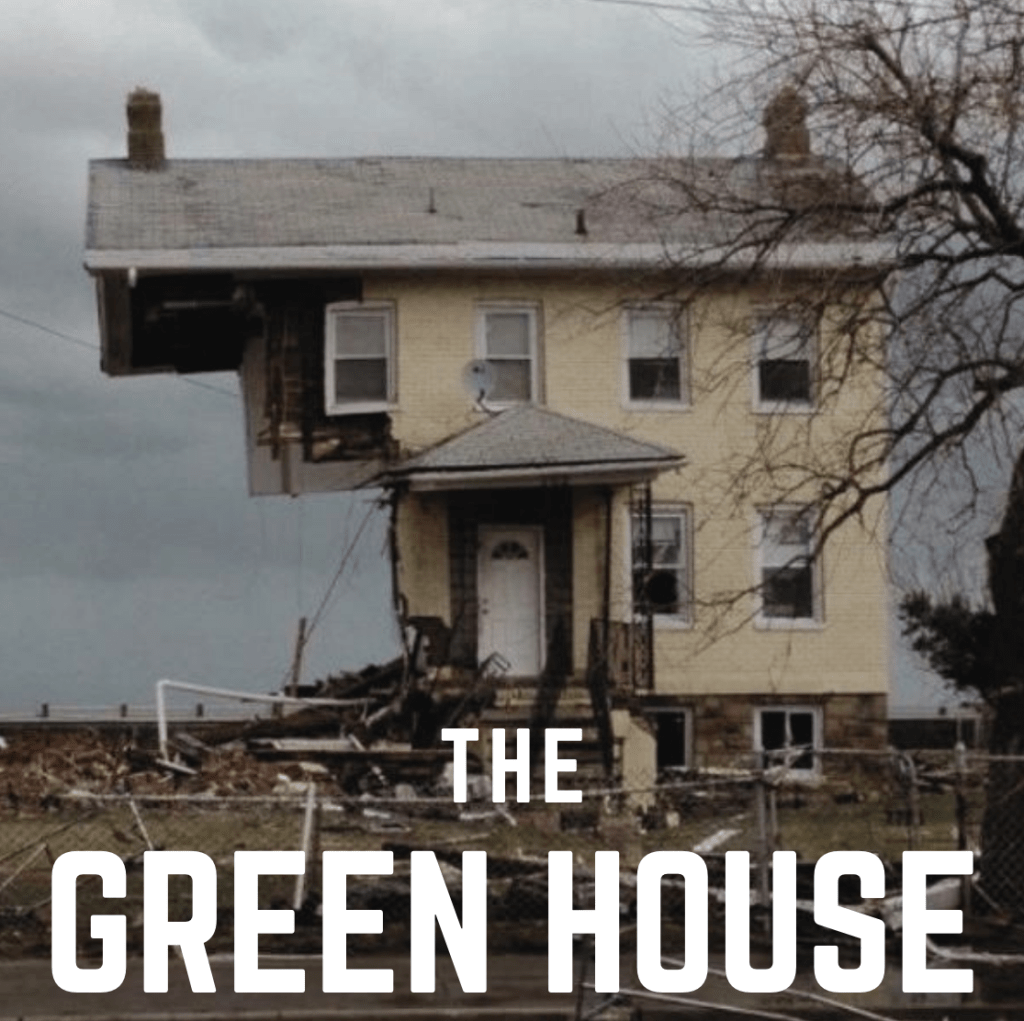
The window screen turned violet as the sun finally sank below the horizon, but beyond the steel walls, there was no green field. The sky churned, black with storm clouds. The hurricane’s rain pounded the oversaturated earth. Its high winds tore at what remained of the house, peeling away each shingle, stripping aluminum siding off in sheets. The Greens’ house was in ruins, but their Singer Industries, Quality Safe Room stood stubborn and windowless in its midst. Blind to the devastation around it as a heavy cloud of smoke billowed from its chimney into the curtain of rain.
 S. M. Nesheim